Bhagwad Geeta: The song divine
The Hindu mind has always been an inquisitive mind. Enquiry and realisation have always been the fundamental prerequisites of life in the typical vedic culture.
Although we see off course versions of life in Hindu Sthan nowadays, but in its core still the guiding principles are very much the same. Being curious is the key to obtaining the knowledge behind any phenomena being it perishable matter or eternal consciousness, curiosity leads to realisation.
It is widely held in the Hindu life sciences that each and every living organism is a manifestation of a conscious Self known as Jeeva. This Self is an entirely conscious entity that seeks to realise via the Matter or Prakriti. A bonding of this consciousness and matter culminates into one of the many dimensions of existence, called the Physical dimension, or the material world, Padarth Jagat. This dimension is characterised by a unique arrangement of physical atoms in various combinations that makes it possible for the Jeeva to tread through. It is assisted by a set of instruments known as Antahakarana (Antah= Inner; Karana= Instrument). This instrument is Mind, Intellect, Sub conscious & Ego clubbed together as the faculties of mind. They are necessary in establishing a chain of communication between the Self and the Matter. Also through these faculties the associations of life are developed and conscious self is provided with knowledge and realisation.
Five Senses or Indriya, as called in Sanskrit, are the connectors as well as routers of signals inwards from world to Self and from Self to the world. It is through these senses viz; Vision, Taste, Smell, Audition and Touch, that the functions of cognition, discrimination and association are activated and the Jeeva interacts with the outside world.
Physical body is the platform where all these activities are organised and executed. This complex arrangement of matter and consciousness is what is perceived by us as our world. However most of us do not have any firsthand knowledge of this complexity and we live in a kind of compositional awareness about all the above mentioned substances. That’s how an ordinary living experience is inculcated.
Hindus believe that this individual consciousness is a direct elemental derivation of the Supreme Consciousness which is the only existing reality. That is called upon by various names across the traditions. Braham, Ishwar, ParamAtma, Bhagwan, God and many more. But the central idea behind all these abbreviations is the non dual Universal Self. This Self is ever present, imperishable, the only reality that is ever existent. So every living being is a miniature of divinity in itself and is very much conscious as we all are. The difference is at the level of the faculties through which this consciousness is expressed and manifested. That is why a vivid diversity exists in the biological world as we see it in the behavioural models of different living species.
We learn in the yogic tradition that there are around 8.4 million species in the mortal dimension through which a Jeeva steers in its journey through this dimension. One after the other, this evolution is from the least expressive to the most expressive life forms. From microbes to fully developed human beings, a Jeeva goes through each life form experiencing and obtaining realisations from each of them. A human birth is considered to be of highest importance as the faculties of Antahakaran are most capable of expressing and acquiring the knowledge at this point. Also in human form, a specific characteristic of Spiritual inquisitiveness evolves. This spiritual inquisitiveness is not to be confused with a temporary feeling of Self Gratification or Emotional connectedness. Rather it is concerned with a sharp notion of enquiry into the purpose of life and the search of the permanence behind the all pervading impermanence in the material world.
A spiritual mind ask questions. Questions about truth, reality and life. Questions that reflect a longing for realising the absolute. Because in the inner core, every living being is connected with that higher divine Self. Although most of us have no clue in our minds or intellects about this relation, yet we long for that relation and feeling of contentment. A contentment that cannot be met by any material desire or fulfilments.
Since time immemorial, people in Vedic tradition, have tried to realise this and then to express that which is known. These expressions by several different individuals have been compiled in the form of Scriptures that are unique in themselves. Because they do not adhere to mere beliefs of an imaginative entity as God, rather they are direct realisations of thousands of individuals in a long lineage of human race where the fathoms of existence have been revealed through different analogies, terminologies, maxims, linguistics depending upon the perceptive abilities of listeners and seekers.
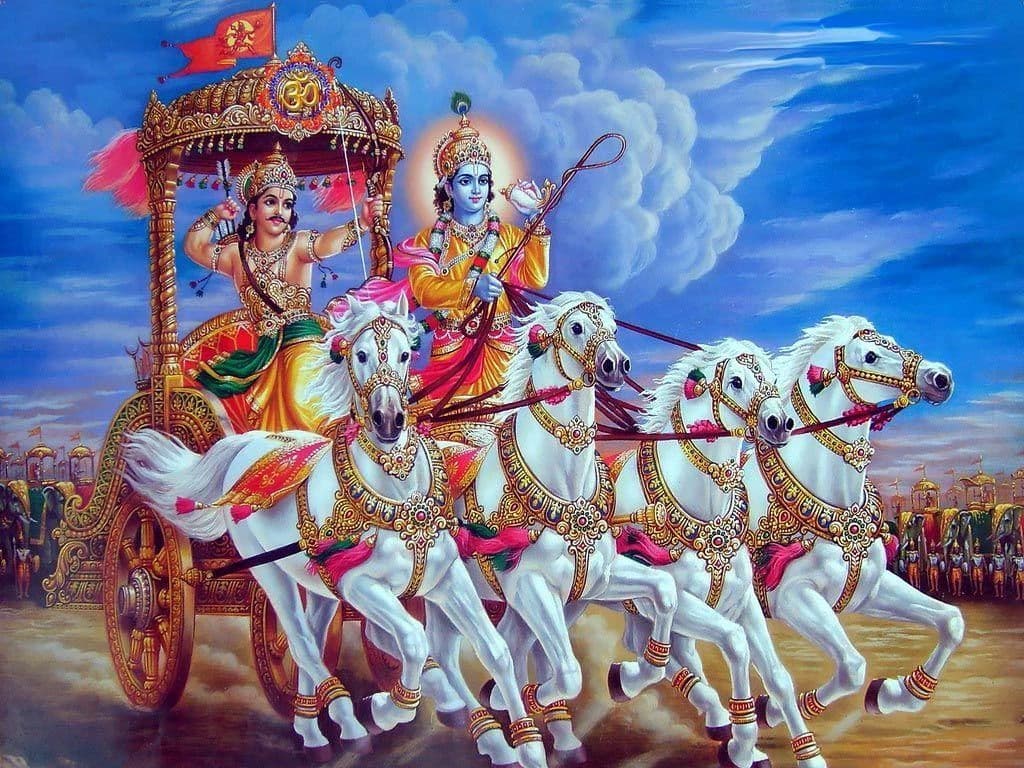
In an uncountable range of such scriptures, Bhagwad Geeta is a Shining Polar Star, which stands unique in the Spiritual sky of Hindu culture. This scripture is a sub section of the greatest epic of the world known as MahaBharat. Geeta is a recorded account of a dialogue between two individuals. One of them represents the individual consciousness, whose name is Arjun, and the other one represents the infinite, expansive Universal Consciousness, whom we know as Lord Krishna.
Actually it’s a very old hindu custom to identify any divine expression in this world with Godhood. That is why you will find people in india still sitting around trees performing rituals. Praying, offering flowers, scents, tying threads, asking for prosperity. It’s a timeless cultural trait that is followed in almost every household without fail. These traditions were kept alive since millennia especially in the hands of Women who hold a special place in the social and family structures of hindu societies. The reason for all these practices is simple. Anything that makes our life possible on this planet in this dimension is considered as a divine entity. And out of gratitudes we pay our regards and offer whatever best we have.
In the west, its very recently, that people and groups have started talking about gratitude, ecological awareness and sustainability. It’s a very bright and positive beginning. However in the subcontinent, these virtues have always been a part of life and a daily ritual for most of us. We worship the trees hence for a very long time the industrialisation of timber was out of context as trees are also considered to be a living being and it’s not an ideal practise to chop them down. We understood the symbiotic relationship between elements and living beings and always preferred to stay in a harmony with all of them which is at the core of the current ecological movement. That’s what kept this civilisation running and flourishing for thousands and thousands of years. And even more.
So it was befitting to give a status of godhood to all those individuals in whom the divinity has expressed itself in its full blossom. Lord Krishna was a mortal being who was born with specific characteristics that held him to that divine status. This feature also makes it clear that any and every human being is in him/her self is capable of qualifying to that state of divinity.
Bhagwad Geeta is stated to have appeared around 3200 BCE, i.e. 5200 years from today as a conversation between two friends of lore. Yet its relevance is still the same today. It is considered to be a crown jewel of all the vedic literature on spirituality. Some authors and sages even consider it as a supreme doctrine on human psychology.
Geeta specifically speaks of Yoga as a quintessential aspect of human life. There are 18 chapters in Geeta which contain 700 shlokas or statements. The topics covered are related to the plight of a man who is standing on the verge of war and is struggling with his inquisitiveness. Arjun, the warrior prince, on the face of the biggest battle of his life, where he was standing against the oppressors of his rights and righteousness. And right there he was bewildered with questions about the purpose of this existence, this life, actions. He suddenly went into a panic state and started trembling with doubts and indecisiveness. His mind was baffled with strokes of uncertainty and was in a confused state.
Krishna came to rescue at that time as Arjun started asking questions about spiritual subjects in the middle of the battlefield. He explained to Arjun the very essence of yoga and its application in life. He unfolded the knowledge about distinct branches of yoga to Arjun who was in a dire need at the time. Primarily he established certain points that can be summarised as below:
- Atman or Self is unanimous to all irrespective of the species.
- Existence is characterised by two primordial elements viz Consciousness and Matter.
- It is the birth right and also responsibility of each individual to realise the Self.
- The spiritual quest to Self realisation is possible in every walk of life. You do not need to qualify or migrate to a possible state in the near future. Just like Arjun was given the discourse right in the battlefield.
- There are three primary categories of individuals based upon which three primary branches of yoga are established and prescribed.
- Karma Yoga for those inclined towards action
- Gyana Yoga for those inclined towards knowledge
- Bhakti yoga those inclined towards emotions.
- Apart from above three, several other forms of Yoga were depicted like Dhyana yoga, Hatha yoga, Lay yoga etc.
- The supreme essence of this existence is the only reality in Whom we all exist. There is no distinction between god and world. They are essentially one.
Therefore Geeta is like a flashlight for all those who are wondering in darkness and are looking for a support. It is free of any limitations of race, caste, creed, country, culture or religion and is equally relevant for entire human race. Yogis consider it to be the most revered and divine expression from the lord of Yoga himself. Shri Krishna.
Thank you. .